16-12-2024
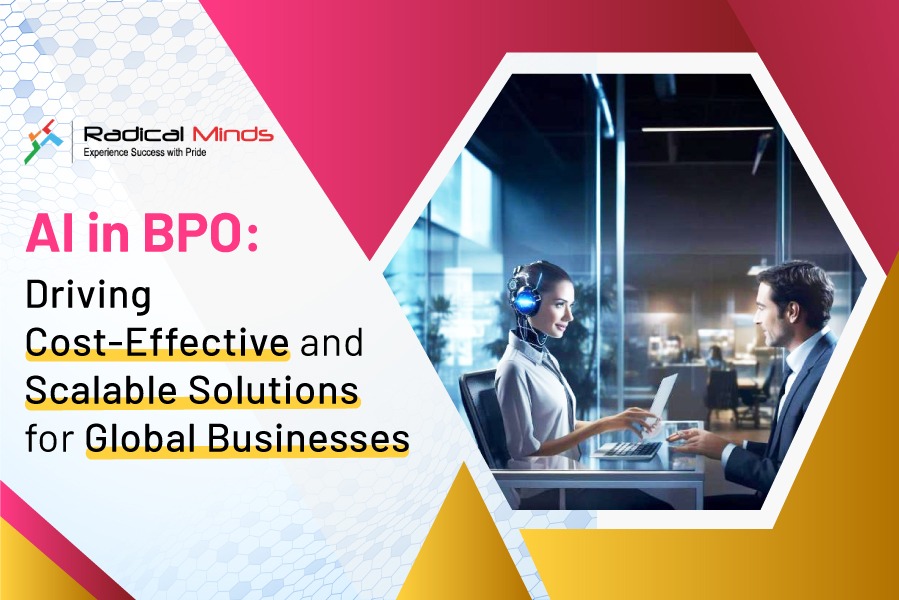
AI in BPO: Driving Cost-Effective and Scalable Solutions for Global Businesses
There never has been a time when all things count, and customers ever demand instant, personalized service. Business Process Outsourcing (BPO) has not been new to any company that requires business operations to be streamlined for efficient and cost-effective services in terms of quality. Truly, the traditional BPO models have failed to meet the rapidly shifting customer expectations and business requirements. Enter Artificial Intelligence (AI) a game-changer completely transforming the landscape of BPO, making available a new paradigm of intelligent, cost-effective, and scalable solutions.
Business Process Outsourcing (BPO) has become more critical than ever for companies seeking to optimize operations, scale efficiently, and improve customer service in this increasingly digital world. The BPO industry itself is also going through a sea change with the advent of Artificial Intelligence in BPO. BPO providers are innovating their services, equipped with AI, to provide efficient cost-saving and scalable solutions for global businesses. Whether this is in improving customer interaction or back-office operations, AI opens avenues through which BPOs could meet the modern demands of business while going beyond them.
Let's dive deeper into the future and explore how AI call center software, predictive analytics, automation, and machine learning are transforming the BPO industry and positioning it to be an agile, data-driven power for global businesses.
The evolution of AI in BPO: From Automation to Intelligence
AI in BPO: From automation to machine learning, NLP, predictive analytics From the automation of repetitive tasks that reduce the cost for companies to deeper insight into the customers, understanding their needs, and tailoring products to their specifics, impossible until now; AI in call centers as well as other BPO domains is a tool for enabling businesses.
The modern AI call center software uses machine learning algorithms to analyze the customer interaction in real time, measuring sentiment, intent, and urgency. This kind of technology can improve the experience for both customers and agents by offering real-time suggestions that guide responses and even predict issues before they happen. The result is faster resolutions, higher customer satisfaction, and significant cost savings related to traditional customer service models.
Cost-Effective Solutions: AI Reduces Operational Expenses in BPO
A really important advantage that AI provides to BPO is being able to decrease the operational expenditure of a company by as much as possible. All that labor-intensive workforce-a huge group of employees-working on monotonous data entry or transaction processing for example-are no more required from BPO outsourcers as AI machines can themselves handle the considerable majority of repetitive work for an enterprise. This range includes everything from simple transaction processing to answering customer inquiries or simple calls. An example for it can be taken from an AI-powered virtual assistant-the thousands of inquiries they manage on the go are supported by perfectly replicative answers that reflect no loss in quality in the service.
According to what was said above, AI call center software may help companies take their operational smoothing a notch higher. Mostly, virtual agents and chatbots, driven by artificial intelligence, handle most simple inquiries, reducing dependency levels on human agents, or in other words, cut time in handling more value-added tasks. This automation saves not only labor costs but also call handling times because AI can easily provide the necessary information to either the customers or agents. This AI-driven analytics further helps in the optimization of the workforce by predicting demand and adjusting according to it thus further cutting down on costs related to overstaffing or understaffing.
Scalability Made Easy: Leveraging Global Demand with AI-Powered BPO
Today, the global economy requires businesses to be scalable in their BPO solutions. The ability to adapt to fluctuating demand is one of the biggest strengths of AI-powered BPO services. Traditional BPO models often require huge investments in scaling up, because they have to hire and train more people to handle additional workloads. Much of that burden is removed by AI solutions through providing scalable tools that can be tweaked in real-time to suit demand.
The utilizations are that more volumes of customer interactions by the AI-powered chatbot / virtual assistant will be supported at peak times, allowing human agents to concentrate more on the more complex calls and conversations. With this, comes a lower staff requirement, as greater amounts of customer contact become achievable while retaining an existing or low head count level. Moreover, by building business intelligence and analytics into such operations, organizations base their decisions more effectively according to actual resources used. Predictions as to how demand is set to either rise or fall allow the business and the operations to come closer in terms of aligning.
This system can provide 24/7 customer support, which is beneficial for companies with a global outreach, meaning constant customer service. With AI-powered call center software, BPO service providers will be able to deliver high-quality and reliable service at any time to international customers.
Adopting AI call center software will allow BPO companies to cater to the needs of global customers, thereby making the services more valuable without binding them to the same limitations as traditional models.
Experience has everything in this competitive world of customer service. Today's customers expect fast, personalized service that responds to their needs immediately. With AI call center software, BPO providers can help meet those expectations by improving all interactions. Real-time analysis of data from AI can inform customer preferences, past interactions, or even emotional cues, thus allowing agents to respond more effectively and empathetically.
For example, if a client calls a call center, AI systems can analyze the sentiment of the customer based on voice tone or even language cues that would enable the agent to get back appropriately.
For example, if a customer seems agitated, the AI system could recommend an empathetic tone with relevant solutions regarding the previous interactions involving the customer. Such personalization enhances the experience, making customers feel valued and understood.
Contact center AI further reduces wait time and accelerates resolution time. Virtual agents can answer the most basic questions right away, thereby leaving the complex ones for human agents. Another thing about AI systems is that calls are routed to the particular customer with his kind of inquiry to the agent equipped to answer his question. With this type of routing, transferring is reduced while the correct support is delivered to meet the needs of the customer for loyalty boosting.
Predictive Analytics: AI's Role in Predicting and Solving Issues Before They Even Happen
Predictive analytics is the most powerful role AI plays in BPO, as it can help companies predict the needs of customers and act on future issues before they happen. With huge amounts of data from past interactions, algorithms of AI are able to find patterns and trends which could indicate a future problem. For example, if the same product or service keeps causing a high volume of calls because of some recurring problem, then AI can flag such patterns for BPO managers to act in advance.
Predictive analytics can also be an optimization tool, with some predicting demand. For example, AI can be used for historical data analysis in regards to when call volumes will shoot up, and this enables providers to prepare ahead of time to ensure that customer wait time is reduced and customers end up satisfied, as a result of having improved service. This improves the whole operational efficiency of using optimal resources.
With the predictive analytics capability through AI-powered call center software, there is improvement in decision-making processes. It will indicate BPO providers on what behaviors of customers are expected with recommendations for improvement on which product features, marketing, or other ways to engage and capture the customers' attentions, which would make any business have informed decisions made, thus ensuring growth, increased loyalty, and profitable for a long time.
AI-Guided Training and Development: Developing the Knowledge Workers of Tomorrow
BPOs are not just changing the way customers interact but also the way training and development is going to transform. Advanced analytics from AI allow BPO providers to find the skill gaps within teams and provide specific training for improvement of performance. The AI-based call center software can track the interaction of the agent with customers and thus, there is real-time feedback on communication skills, issue resolution, and compliance. It allows BPO providers to provide specific training to each agent based on their needs for continuous improvement and enhancement of overall performance.
Another benefit is the experiential learning by simulation and virtual training environment. For instance, complex customer scenarios can be mimicked using AI simulations; this will give the agents the opportunity to train and develop their skills risk-free. This hands-on experience, especially for tough interactions, is helpful for developing agent confidence and making it easy for them to handle their issues well.
BPO can actually invest in AI driven training and development and would ultimately build a highly skilled team capable of delivering high standard services to the customer with this focus on agent development adding on to the service delivery and also improving the worker satisfaction and retention because more people feel empowered and confident.
The Future of BPO: AI as Strategic Business Partner
The rise of AI into BPO heralds the rise from transactional outsourcing models towards a more strategic collaboration model. BPOs are no longer performing a low-end back-office support and now are integrated business functionalities with their clients' use of AI to fuel innovative development, customer experience value chain improvement, and providing new-found insight. With companies utilizing BPO solutions empowered with AI, the scope and function of BPO suppliers will change from being merely suppliers to strategic consultants for an organization.
We will see AI call center software and other AI-driven BPO tools getting further sophisticated with deep learning, cognitive AI, and many such emerging technologies. All of this will help the BPO service providers in offering highly niche-specific and personalized services with much greater customer experience support in their business growth journey. Multilingual support, real-time language translation, predictive maintenance, and fraud detection are just a few of the ways AI is going to continue to broaden the possibilities for BPO solutions, making them more dynamic and adaptable to evolving business needs.
Embracing AI-Powered BPO Solutions for Competitive Advantage
AI-powered BPO solutions will give a direct route to success for companies looking to thrive in today's highly competitive marketplace. BPO providers can use the powers of AI to deliver cost-effective, scalable, and quality services that enable businesses to focus on their core competencies. From enhancing customer interactions through AI call center software to streamlining back-office operations, AI has the potential to transform everything in BPO.
Adoption rates of AI-driven BPO solutions will increase even faster as companies continue to seek the most innovative ways to run their operations efficiently and get better customer satisfaction. It is not a trend or a fad, but a change of practice promising to redefine and change the ways of global business operations and the customers' engagement of a specific business. In fact, for businesses ready to leverage this technology, there may be unprecedented opportunities for increased growth, efficiency, and customer loyalty.
Conclusion: BPO in the New Era of AI Transformation
The integration of AI in BPO is catapulting customer service and operational excellence into a new era by fundamentally changing the way businesses interact with and serve their customers. By using AI in call centers, BPO providers have unlocked a new level of efficiency, bringing faster, more accurate, and highly cost-effective service. AI takes care of all the automations easily and redundant tasking, while predictive insight allows companies to predict demands and proactively address them. BPO solutions brought about by AI not only reduce operational costs and offer increased scalability but also enable a business to deliver an amazing, personalized experience to their customers.
By embracing AI-powered call center software and the rest of the AI-innovative solutions, businesses stand at great advantage in highly competitive surroundings that require responsive, specialized service. The near future and beyond for BPO will definitely be full of dynamism if AI is the starting point towards transformation and development. The companies best positioned to lead innovation will be those that tap into AI-driven BPO solutions by upgrading the customer experience and capitalizing on new opportunities.