
30-06-2025
The existing fear of a worldwide recession is affecting many industries and raising re-evaluation of business strategies. The recession's ripple effects reached the BPO (Business Process Outsourcing) companies and changed their landscape and paradigms of doing business.
Organizations face cost pressure, recalculating outsourcing models, focusing on efficiency, and prioritizing remote work environments. Initiatives, such as optimization, new technologies, and staff retraining, played a critical role.
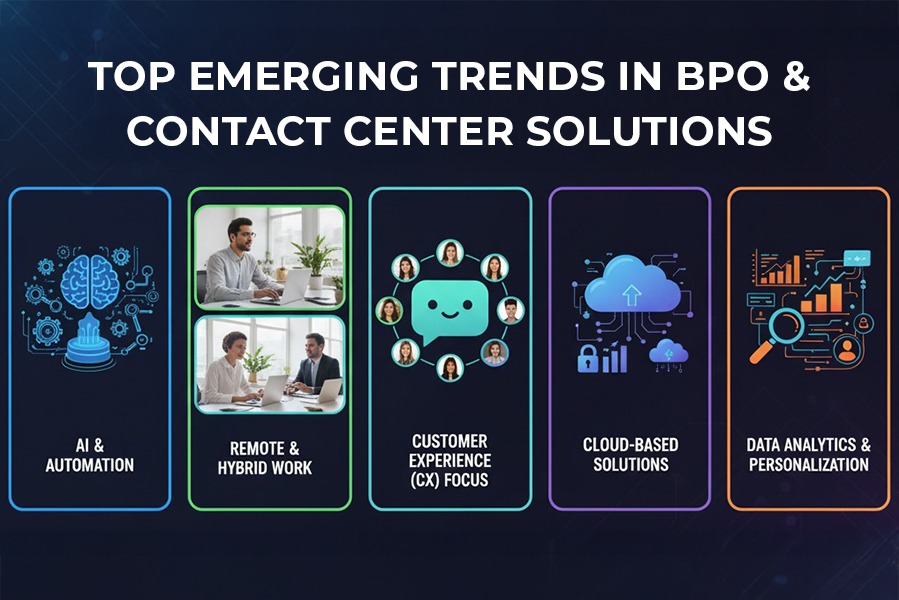
Looking forward to 2025, companies are developing strategies that scrutinize the emerging BPO trends due to the increased importance of foresight in uncertain situations. This blog will discuss how BPO technology trends influence the future of contact center outsourcing and take the businesses to the next level.
Business Process Outsourcing and Contact Center Solutions Landscape
The business process outsourcing field is no exception as trends shift with the rise of the technological aspect, growth in competition, and consumer shifts.
These trends have dominated the BPO world over the past years and may continue until 2025.
Artificial Intelligence
Artificial Intelligence (AI) is growing rapidly globally, and its effects on BPO can't be overemphasized. Among the top trends in outsourcing contact centers, AI systems play a great role in digitalization, optimizing multiple computational operations and making it easier for customers to work with.
Such a phenomenon as machine learning has radically changed what customer service is and what it accomplishes. They allow BPO firms to identify customer care problems quickly than human interaction. It has also enhanced the pace at which data is captured through artificial intelligence in documentation. A chance of making errors is also reduced, and a BPO provider can perfectly follow the claims, invoices, customer files, applications, etc.
Lastly, AI in outsourcing plays a significant role in steering customer purchases. Through AI, the BPO companies can collect data on behavioral patterns, preferences, and retention levels to advance the quality levels of client services.
Give Emphasis to Process Automation
The modern BPO industry is largely based on advanced technologies. Communications technology and the availability of the internet make outsourcing a feasible option, and in recent years, automation has been used to minimize monotonous work and cut down manual labour. It also contributes to increasing accuracy, efficiency, and productivity.
This year, BPO anticipates robotic process automation (RPA). The third-party service providers have begun to automate their business processes. In particular, BPOs have collaborated with life sciences companies to implement RPA in business processes, including medical writing, clinical data management, and research and development.
Omni-channel Solution Utilization
The omnichannel solution lies in applying multiple channels through which you communicate with your customers. A report by the Harvard Business Review revealed that 70% of Shoppers choose to purchase across a channel, 7% purchase online, and 20% buy in-store.
Omni-channel solutions offer access to products or services through many online channels, digital destinations, and mobile devices, and customer care is offered via social media, live chat, email, and a call center, besides using your site.
Omni-channel solutions have improved many businesses with enhanced global exposure, customer interaction, and customer satisfaction. Outsourcing helps to make your omnichannel strategies believable.
Green Sustainable Outsourcing
With increased environmental and social consciousness worldwide, sustainable outsourcing is becoming a priority. In 2024, several BPOs began implementing sustainable practices, like reducing the carbon footprint (e.g., energy-conserving business activities and remote work that reduces emission levels).
Sustainability is the main focus of the outsourcing trends. The markets will concern businesses requesting BPO partners that maintain environmentally friendly ethics and ethical labour. This also involves the proper/responsible use of green technology, implementing a circular economy pattern, and providing good working conditions to the employees.
In addition, sustainability certification and transparent reporting of the BPOs help them to build trust with the clients and stakeholders they serve. BPOs can emerge as leaders in the competitive market by enshrining sustainability in their core business, making it easier to achieve global societal and environmental objectives.
Automation with Workforce and Robotic Process Automation (RPA)
Automation is restricted to customer-level interaction and applies a sweeping change to the back-office system. Robotic Process Automation (RPA) will begin to simplify rule-based/routine work activities, including data entry, billing, creating reports, validating compliance, increasing efficiency, and preventing human error.
Since bots can handle repetitive tasks, human agents can concentrate on difficult, value-added interactions that involve understanding human problems and being empathic. Such a balanced path scales up production, significantly lowers operational expenses, and improves the quality of service. RPA also entails a faster processing time, which results in faster service delivery.
Transformation of Centers of Cost to Centers of Revenue
Contact and call centers were usually regarded as cost centers until recently. However, fortunately, not anymore. In the last 10 years, most companies have radically transformed their mindset concerning the purpose of contact center innovation and the customer experience.
Adopting AI, Robotic Process Automation (RPA), speech analytics, generative AI, chatbots, and other call center automation tools in the contact centers has contributed significantly to making them profit centers.
According to studies conducted by Calabrio, 88% of contact center administrators worldwide reported that customer care directly influences revenue and profitability. This transition is self-explanatory, with most current businesses operating via customer experience competition. Statistics show how consumers buy and remain loyal to a brand based on customer experience, how rapidly they might switch to a competitor after a bad service experience, and how much brands lose to poor CX.
Remote Working
The COVID-19 crisis demanded that most BPO firms transition into a remote working structure. This enabled them to be active in peak seasons despite lockdowns, curfews, and other pandemic limitations. It is initially difficult since outsourcing services used to be on-site. Nevertheless, many BPO organizations have experienced improved staff productivity, morale, and performance, and reduced operational costs.
Although during COVID-19, the restrictions are no longer applied, outsourced service providers chose to preserve remote paths. Others even tried hybrid arrangements. In the larger context, remote employment is being replicated to some extent beyond business process outsourcing.
Firms understand that the on-site presence of employees does not always connect to improved production. Moreover, the same companies save more by not investing in a physical office location. General employee attitudes are still boasting of the benefits of remote work. The flexibility and control provided to employees are improved, and business process outsourcing firms offer these advantages, increasing employment and retention levels.
Cloud Computing
BPO Cloud computing has massively revolutionized the BPO sector, and businesses can enjoy higher efficiency, scalability, and cost-effectiveness in their operations. Their ability to share and store massive amounts of data, run applications, and carry out processes online made cloud computing a standard in the online work of most companies.
With cloud-based solutions, companies have more flexibility as they can scale up or down their disposition according to the requirement. It makes costly infrastructure investments unnecessary and reduces the cost of operation. Besides, having everything in the cloud, businesses can organize their processes more efficiently and are less prone to data redundancy and inconsistency.
Distributed and remote employees get crucial information with minimal security risks. In addition, cloud services have robust backup and disaster recovery.
Consumption of Generative and Conversational AI
Generative AI and conversational AI provide a new era of smart customer experience. Integrating texts such as the OpenAI chatGPT and the Google Bard is also being implemented into contact center technologies to make their communication smarter and context-specific. Such AI can produce dynamic and natural-sounding responses, which can assist them in offering better service or even serving low-complexity cases without any direct input.
The outcomes are improved self-service, decreased wait time, and increased agent efficiency. With an improved generative AI, their ability in knowledge base generation, training, and multisupport is also going to increase.
Voice Biometrics and Superior Identity Verification
The issue of identity theft and fraud continues to grab the spotlight, and voice biometrics is becoming the popular choice in contact centers. This technology uses distinctive voice patterns that allow appropriate callers to use without requiring PINs or security questions.
With fraudsters increasingly becoming smarter, there will be a proliferation of voice biometrics and AI-facilitated verification solutions in high-security customer service processes.
Conclusion
More advanced technologies drive this paradigm shift in the BPO and contact center industry, causing a changing workforce profile and a higher level of customer expectation. Whether it is the benefits of AI-enabled automation, the path towards sustainability, or the remote working model, the industry is no longer about making it cheaper but ensuring a smooth, intelligent, and purposeful customer experience.
Accommodating these emerging BPO trends is not a choice but a strategic approach for the organization desiring to exist in a more digital and customer-centered world. BPO providers that unconditionally welcome innovations and meet these dynamic expectations will be better positioned to realize value-based results and growth.
FAQs
Why is omnichannel engagement crucial in contemporary contact centers?
The omnichannel interaction is present and consistent across telephone, email, chat, and social applications. It gives the agents access to a general understanding of the customer interaction and enhances efficiency and the whole customer experience.
Does remote and hybrid work apply to contact centers?
Given the appropriate dials, training, and supervision mechanisms, the remote agents can go even farther than the conventional ones and show the same or even higher results, providing increased flexibility and workforce retention.
What are the largest technology trends in BPO and contact centers nowadays?
The largest ones are AI-based customer service, cloud contact center, robotic process automation (RPA), and Omni communication. These innovations increase customer experience, cut costs, and make it easy to scale operations.
What is the role of AI in customer service at the contact centers?
AI is applied to automate regular queries using chatbots and sentiment analysis, make real-time agent suggestions, and personalize. It contributes to a quicker customer response and customer satisfaction.