
13-02-2026
Every food delivery platform knows what happens around 7:00 PM on a Friday.
Orders spike fast. Support tickets pile up even faster. Customers start checking their phones every few seconds, wondering where their food is. Within minutes, response times stretch, queues grow, and service levels slip.
In many cases, ticket volume jumps by close to 300 percent in under half an hour. Customer satisfaction drops sharply, and teams spend the rest of the evening trying to recover.
This is not because support teams are underperforming. It's because most support systems were never designed to handle demand like this.
Radical Minds Technologies works with food delivery brands facing this exact situation. The goal is not to replace people or flood teams with new tools, but to redesign how support works during peak hours so it doesn't collapse under pressure.
Most food delivery support requests are predictable. Industry data shows that more than 80% of tickets fall into a small set of categories: order status, delivery delays, payment issues, and refunds. During peak periods, order status questions alone can account for nearly half of all incoming volume.
The problem is timing.
Delivery platforms typically see the majority of daily orders concentrated into two short windows. Staffing human agents to fully cover those spikes is expensive and inefficient. You can't realistically hire hundreds of agents to work for a couple of hours each evening. Training takes time, and by the time agents are ready, the peak has passed.
As queues grow, customers wait longer for simple answers. Once wait times cross a few minutes, frustration rises quickly. Frustrated customers take longer to handle, which slows queues even more. The cycle repeats until SLAs are missed and teams fall into reactive mode.
This is where most platforms lose control of the customer experience.
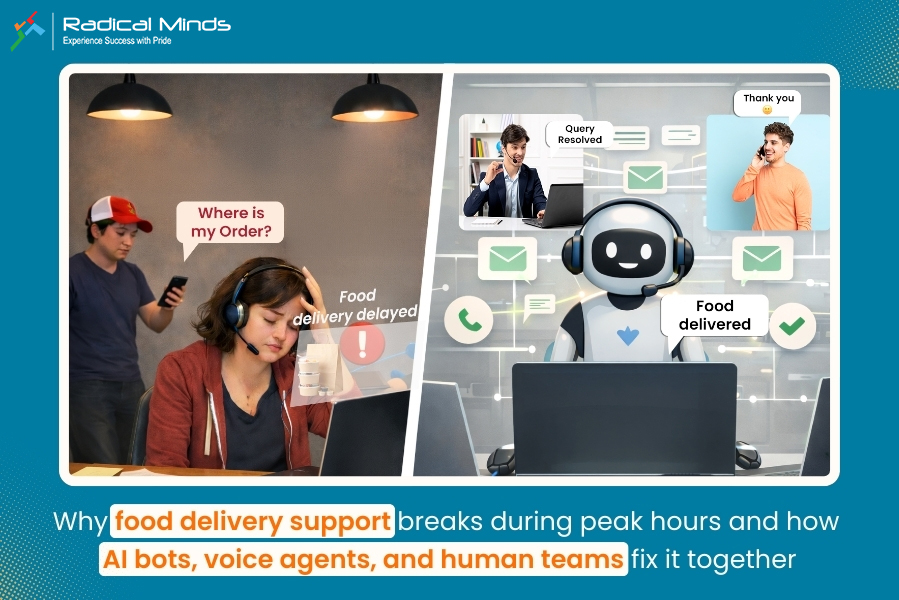
Level 1 tickets are repetitive by nature. Questions like u201cWhere is my order?u201d or u201cCan I update my delivery instructions?u201d don't require investigation or judgment. They require fast access to accurate data.
AI bots are well suited for this layer of support. When connected directly to order management, payment, and delivery systems, they can answer these questions instantly. Customers get updates in seconds instead of waiting in line for an agent.
In real-world deployments, it's common for AI bots to resolve 60 to 70 percent of L1 tickets without human involvement. This immediately reduces queue size and frees human agents to focus on issues that actually need attention.
The cost difference matters too. A ticket handled by a human agent costs several times more than one resolved automatically. During peak hours, that gap becomes a serious operational concern.
Chat support alone doesn't cover all customer behavior. During peak hours, many customers still prefer to call, especially when orders are late or incorrect.
Voice queues are often where the biggest breakdowns happen. Callers wait longer, frustration builds faster, and agents inherit conversations that are already tense.
AI voice agents address this gap by handling routine calls the same way bots handle chat. Order status updates, delivery timing, store information, and basic refund checks can be resolved immediately over the phone.
When voice agents handle these predictable calls, human agents are reserved for situations that require judgment, empathy, or escalation. Calls that need a person are routed correctly from the start, without forcing customers to repeat themselves.
The result is shorter wait times, lower handle times, and a calmer support environment during peak hours.
Automation does not replace human agents. It protects them.
Complex issues like billing disputes, food safety concerns, or emotionally charged complaints still require people. What changes is the context. When agents are no longer answering the same basic question hundreds of times, they have the capacity to handle difficult cases properly.
Agents are better prepared, less fatigued, and more effective. Burnout drops. Resolution quality improves. Teams stop feeling like they're constantly behind.
This balance between AI automation and human support is what keeps service stable when demand spikes.
Without any form of automated first response, many food delivery platforms see SLA compliance fall below acceptable levels during peak hours. Response times stretch, backlogs grow, and recovery takes days.
When AI bots and voice agents absorb routine volume, response times improve across the board. Simple requests are resolved immediately. Complex tickets reach agents faster. First response times stay within limits even when order volume surges.
In practice, this often moves SLA compliance from the low 60 percent range into the 90 percent range. That improvement directly impacts customer retention and repeat usage.
One national restaurant brand struggled with long wait times every Friday night. Customers routinely waited close to 20 minutes to reach support. After implementing automated handling for order status and store-related queries across chat and voice, average wait time dropped to seconds.
Another grocery delivery company staffed aggressively to prepare for worst-case scenarios. By introducing an automated first-response layer, they reduced human ticket volume by nearly two-thirds. Staffing costs fell, and customer satisfaction improved at the same time.
In both cases, the biggest win was stability. Peak hours stopped feeling like emergencies.
One national restaurant brand struggled with long wait times every Friday night. Customers routinely waited close to 20 minutes to reach support. After implementing automated handling for order status and store-related queries across chat and voice, average wait time dropped to seconds.
Another grocery delivery company staffed aggressively to prepare for worst-case scenarios. By introducing an automated first-response layer, they reduced human ticket volume by nearly two-thirds. Staffing costs fell, and customer satisfaction improved at the same time.
In both cases, the biggest win was stability. Peak hours stopped feeling like emergencies.
Radical Minds Technologies focuses on fixing how support actually runs. The emphasis is on peak-hour performance, not theoretical efficiency.
Solutions are designed to work with existing CRMs, delivery platforms, and operational workflows. Deployment timelines are measured in weeks, not quarters. Improvements are visible quickly and continue as systems adapt to real usage.
The objective is simple: keep support functional when it matters most.
Peak-hour failures are system problems, not people problems.
Most support demand during these windows is predictable and repetitive.
AI bots and voice agents absorb volume so human agents can do meaningful work.
Speed matters more than anything else when customers are waiting for food.
Support systems must be designed for the busiest hour, not the average one.
Food delivery doesn't slow down at night. Support systems shouldn't either.
Scaling a delivery business requires more than drivers and logistics. It requires a support operation that can absorb pressure without breaking.
Radical Minds Technologies helps food delivery platforms build support systems that stay reliable during peak demand. The result is fewer breakdowns, lower costs, and customers who keep coming back.
If peak hours are still your weakest point, it may be time to rethink how your support is built.